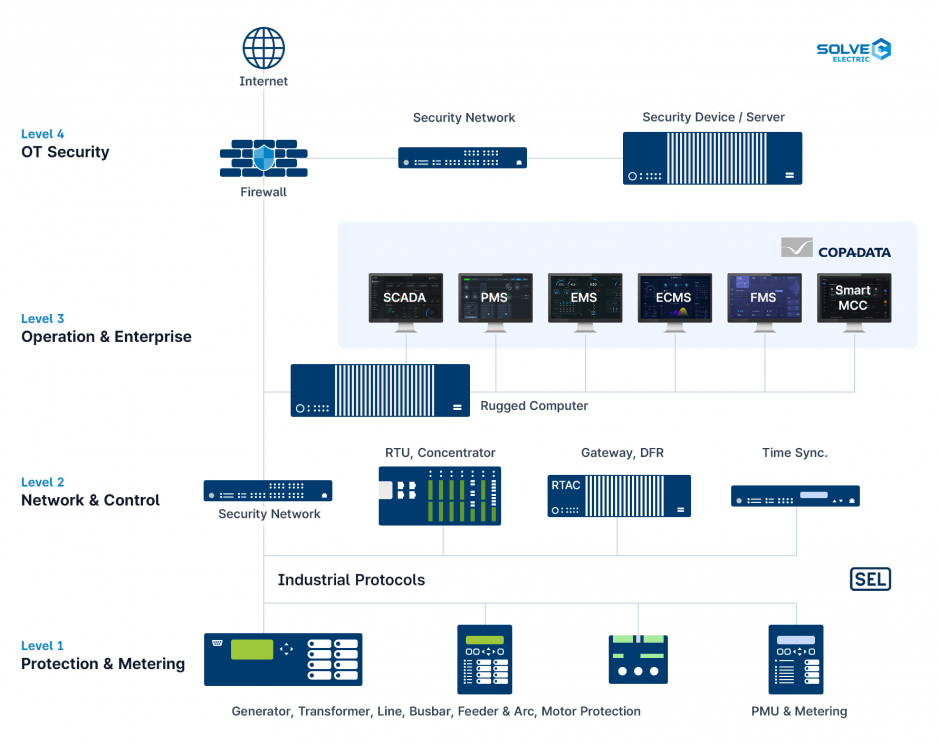
One Platform, Multi Purpose
Resolve complex systemswith Solvec Electric's single integrated platform.
A generator is the interface where mechanical energy and electrical energy are converted, and it is one of the most expensive and complex assets in a power system. Generator protection must address multidimensional threats, including electrical insulation breakdown of stator and rotor windings, mechanical bearing damage, and synchronization issues with the grid.
SEL’s generator protection solutions provide a broad lineup ranging from small emergency generators to large base-load power plants, and they integrate with surrounding auxiliary equipment to form a comprehensive protection system.
A transformer is a key asset for voltage conversion. When an internal fault occurs, the risk of fire is high, and replacement takes a long time—causing major disruption to grid operations. The greatest challenge in transformer protection is distinguishing magnetizing inrush current from a true internal fault.
SEL provides a wide range of solutions covering everything from small distribution transformers to extra-high-voltage transmission autotransformers. In particular, SEL is expanding the protection scope by introducing the concept of Centralized Protection and Control (CPC).
Transmission lines, often extending hundreds of kilometers, are the most vulnerable to faults caused by external factors such as lightning strikes and vegetation contact. The primary objective of line protection is to accurately locate the faulted section and isolate it quickly, thereby maintaining the system’s transient stability.
SEL offers the industry’s most advanced line protection lineup, ranging from traditional distance relays to time-domain relays that overcome the physical limitations of conventional methods.
The busbar is the hub where all power converges and is distributed, and a bus fault is a critical event that can lead to a complete substation outage. The core of busbar protection is to remain absolutely secure against misoperation for external faults on any one of dozens of connected circuits, while immediately tripping all associated breakers for an internal fault.
SEL supports both low-impedance and high-impedance schemes and, in particular, provides solutions that enhance scalability and security by incorporating digital technologies.
A feeder is an asset that directly connects to customers at the edge of the power network and is exposed to the most frequent and diverse types of faults. In particular, arc-flash incidents occurring inside metal-enclosed switchgear are catastrophic events accompanied by explosive heat and pressure.
SEL offers a broad lineup of feeder protection solutions, ranging from basic overcurrent protection to advanced integrated functions such as arc-flash protection and high-impedance fault detection.
Motors are subjected to various stresses such as thermal overload, locked-rotor conditions, unbalance, and ground faults. The key challenge in motor protection is to maximize motor utilization within its thermal limits while tripping accurately just before insulation damage occurs.
SEL offers a specialized lineup capable of protecting everything from low-voltage small motors to high-voltage large synchronous motors.
Power meters are essential tools for monitoring power quality and analyzing abnormal conditions in the grid. Harmonic distortion driven by the growth of nonlinear loads, momentary voltage sags, and bidirectional power flows resulting from renewable energy interconnection all threaten measurement accuracy.
SEL delivers uncompromising accuracy and advanced power quality analysis capabilities.
Industrial networks are like the lifeblood of the power system. As the industry transitioned from the era of serial communications to Ethernet-based TCP/IP networks, bandwidth increased dramatically. However, there are fundamental limitations to applying standard IT Ethernet technologies in OT (Operational Technology) environments—especially in mission-critical settings such as substations.
SEL has redesigned SDN technology from the IT domain for OT use, presenting the SEL OT SDN solution that separates the network’s control plane and data plane.
An RTU has traditionally been a device that collects data from field sensors and instruments and transmits it to a remote SCADA control center. Early RTUs were limited to simple data acquisition and communication functions, lacking the capability to execute complex control logic or handle large data volumes. They were designed to withstand harsh conditions (high temperature, vibration, and electrical noise), but they had limitations in cybersecurity features and support for modern communication protocols.
SEL has gone beyond the traditional RTU concept by defining a new category called the RTAC (Real-Time Automation Controller). The SEL-3555 and SEL-2240 Axion are hybrid platforms that combine RTU-grade ruggedness with high-performance, server-class computing and PLC-like control capabilities.
A data concentrator serves as a bottleneck point that collects data from numerous downstream IEDs (Intelligent Electronic Devices) and delivers it to upstream systems. Traditional devices typically performed only basic protocol conversion or data mapping, and in large-scale systems their limited processing capacity often led to data latency or loss.
SEL RTAC is not merely a pass-through device—it functions as an intelligent data hub.
A substation gateway relays communications and enforces security at the boundary between the external network (WAN) and the internal network (LAN). As cybersecurity regulations have become more stringent, gateways are now expected to provide robust security functions beyond simple data forwarding.
With the philosophy that “security is not a feature, but the foundation of design,” SEL has engineered the RTAC as a hardened security appliance.
When a fault occurs in a power system, accurately analyzing the cause requires precise recording of pre- and post-event voltage and current waveforms (oscillography) as well as the sequence of events (SOE) from associated devices. Traditionally, this required installing a separate, standalone DFR device, which increased cost, footprint, and wiring complexity.
Instead of adding a dedicated DFR, SEL simplifies the system by embedding high-performance DFR functionality directly into Axion and the RTAC.
In a digital substation, if the timestamps applied to data from each IED are not aligned, incident analysis and synchrophasor comparisons become impossible. Therefore, a GPS clock that receives satellite signals and distributes highly accurate time at the microsecond (µs) level is essential.
The SEL-2488 is not just a time receiver—it is a security-focused device that guarantees "trusted time" for the power grid.
Modern SCADA has evolved into an intelligent central operations hub that collects and processes massive volumes of real-time data, integrates with higher-level ERP systems, and executes complex automation logic.
Our SCADA embeds energy-industry–specific capabilities, enabling you to build an advanced SCADA system without writing complex scripts. It also adopts a parameterization approach to reduce engineering time and minimize the likelihood of errors.
PMS performs active control functions such as power balancing, frequency and voltage regulation, and generator control. In plants with on-site generation or in islanded microgrids, core PMS functions include load shedding, generator load sharing, and synchronizing control.
Our PMS includes an IEC 61131-3–based logic engine, allowing complex PMS algorithms to run directly within SCADA. This simplifies the system architecture by enabling high-speed control logic without a separate PLC.
If PMS focuses on power system stability, EMS focuses on the consumption and efficiency of all energy sources—electricity, gas, water, steam, and more. Its primary role is to support ISO 50001 energy management certification, manage energy performance indicators, and analyze energy consumption relative to production output.
Our EMS integrates not only field metering data but also status data from production equipment, providing contextual information on “how much energy was used while doing what.”
ECMS monitors the real-time status of power assets such as transformers, breakers, switches, and generators to maintain asset health, and rapidly isolates the system during faults to prevent escalation. It may also integrate with a DCS (Distributed Control System) to support equipment start-up and shutdown.
Our ECMS enables a highly reliable ECMS by leveraging broad communications compatibility with power equipment and strong visualization capabilities.
FMS manages the end-to-end process of detecting, isolating, analyzing, and restoring faults in industrial systems. Its purpose is to identify root causes amid alarm floods and to analyze pre- and post-event data to establish measures that prevent recurrence.
Our FMS can serve as a core tool for fault management through advanced alarm management and process recording capabilities.
A motor diagnostic system monitors the health of electric motors—the primary power source in industrial sites. By analyzing vibration, current, temperature, and other data, it detects early fault symptoms and plays a critical role in preventing production losses due to unplanned outages.
Our Smart MCC communicates with various vibration sensors and SMTUs to collect diagnostic data, and combines it with powerful trending and visualization tools to deliver actionable diagnostic insights.
An OT-dedicated technology engineered to remove traditional Ethernet switch vulnerabilities. It creates a deterministic network where traffic travels only along flows pre-defined by a central controller, rather than through self-learned paths.
It is a secure operating system and middleware platform for OT environments. It reduces the vulnerability management burden associated with general-purpose operating systems like Windows and provides an environment designed to execute only verified applications.
It is a device that defends the perimeter of monitoring and control systems, performing security functions that go beyond simple packet filtering. It acts as a gateway between external and internal networks, protecting IEDs from direct external attacks.
The OT DMZ refers to a buffer zone located between the IT and OT networks. It prevents cyber threats originating from the external internet or the IT network from propagating to critical assets within the OT network. A robust and intelligent defense system can be established by combining solutions from Fortinet and Nozomi Networks.